
Know what your teams need before the damage shows up.
TeamPulse asks one focused question every day through the desktop app and turns responses into company, team, manager, and dimension-level health insights.
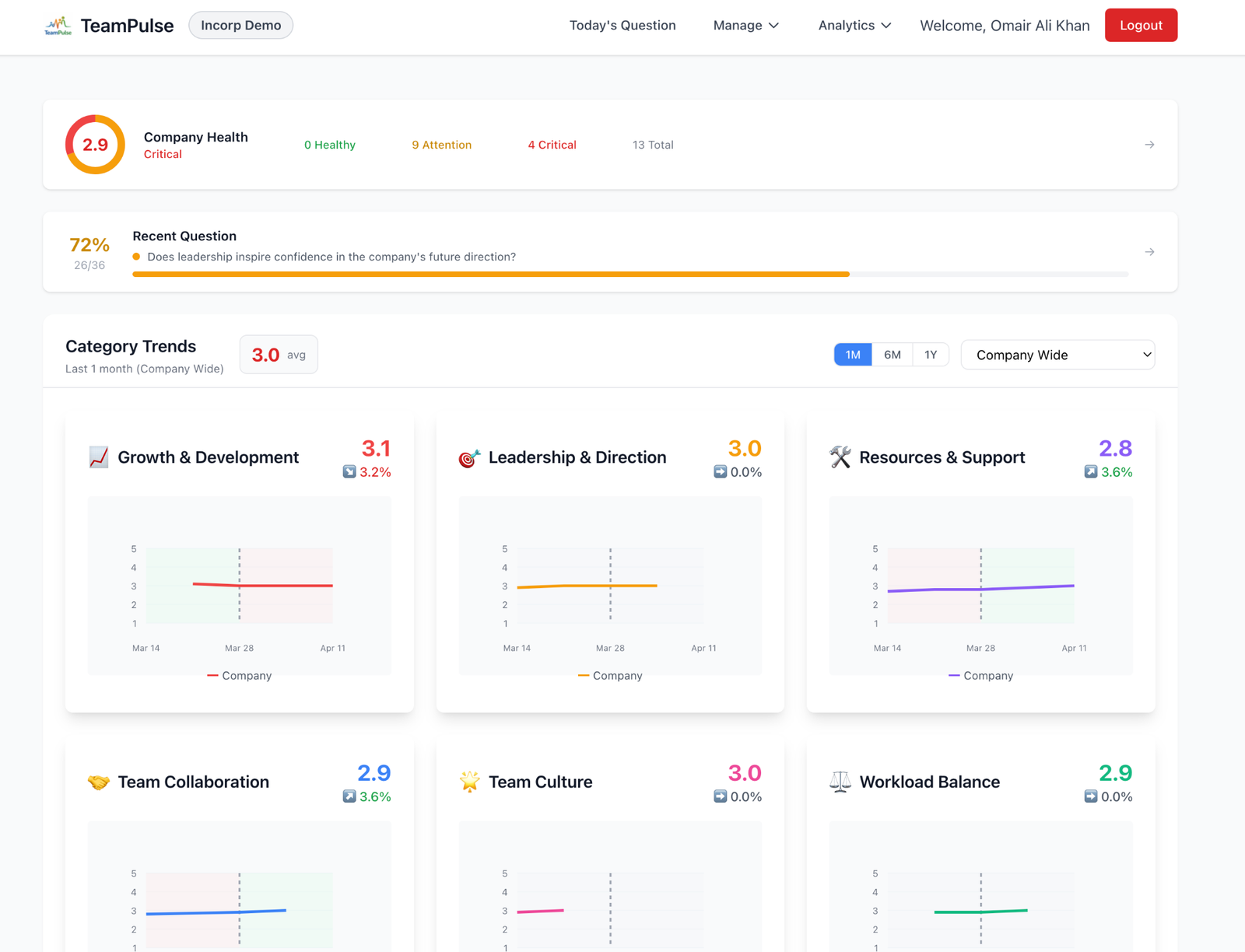
Critical signal
See the teams and dimensions that need attention first.
Annual surveys are too slow for daily team signals.
A company can track every sales metric in real time, yet still wait months to learn that people are unclear, overloaded, unsupported, or losing trust in leadership.
For employees: your voice matters, your identity doesn't
TeamPulse is built for honest feedback. Every response is completely anonymous — no names, no tracking, no way to trace answers back to individuals.
Fully anonymous responses
Your answers are never linked to your identity. Leadership sees aggregated team-level insights only — never individual responses.
One question, once a day
A single focused question appears on your desktop. Rate it 1–5, and you're done. No lengthy surveys, no follow-up emails.
Your feedback drives real change
Responses shape team health scores that leaders use to identify where support is needed — so your honest input leads to meaningful action.
How TeamPulse works
One question a day, answered on the desktop — aggregated into leadership-ready health insights.
Ask one focused question
Employees answer one daily 1-5 pulse through TeamPulse Desktop. No browser tabs. No long survey fatigue.
Map it to a dimension
Each question maps to one of six core dimensions, or to a custom dimension your organization adds.
See team-level risk
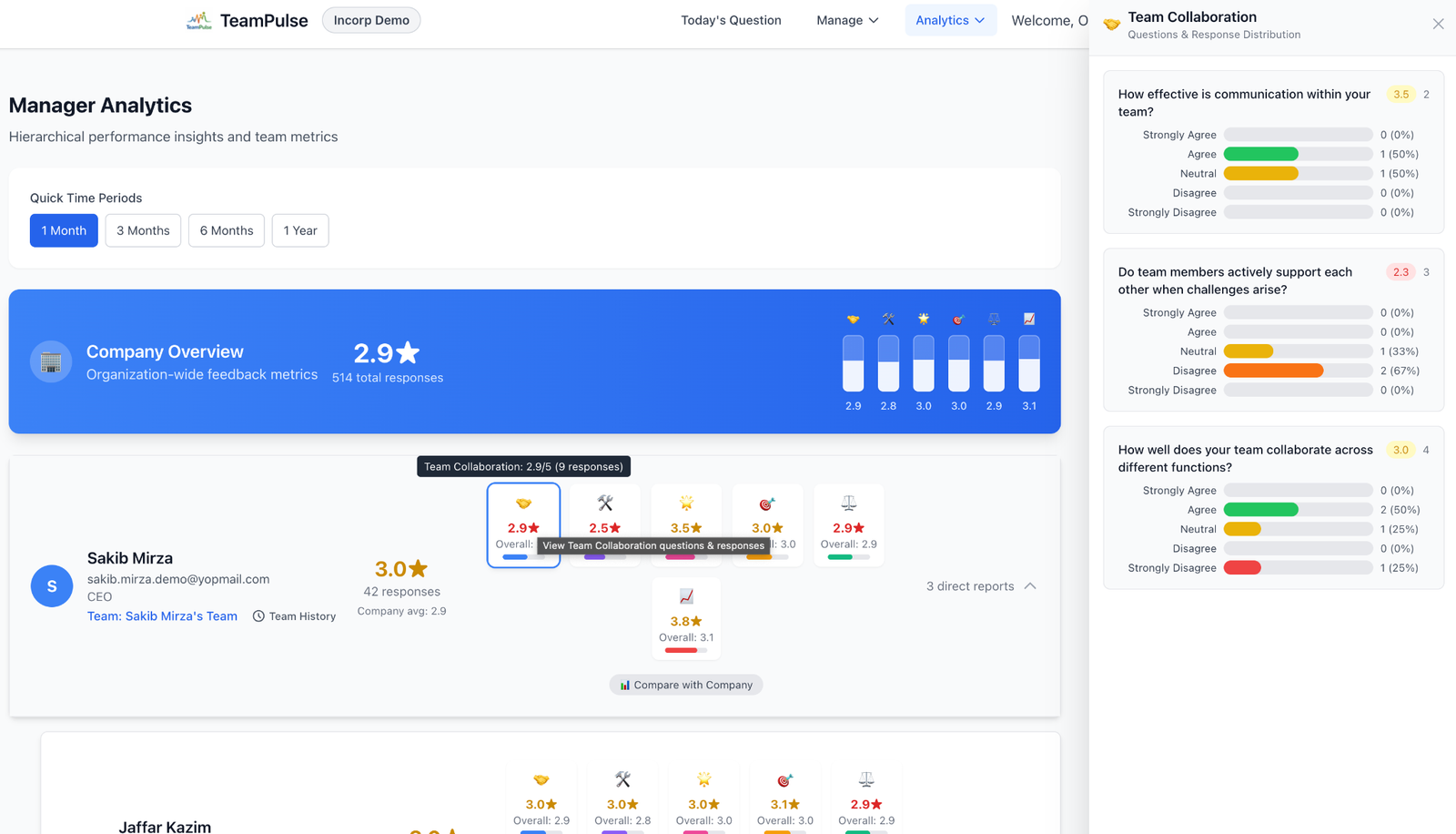
Dashboards show company health, teams needing attention, dimension trends, and response gaps.
Act before it escalates
Leaders know which conversation to have, with which manager, and why.
Built like a management dashboard, not a survey form.
The UX stays clean: a desktop-only question experience for employees, web dashboards for leaders, and detailed drill-downs for managers.
Spot critical teams, response rate, total responses, and overall health.
See completion rate, distribution, and pending responses for the latest pulse.
Compare core and custom dimensions across teams and time periods.
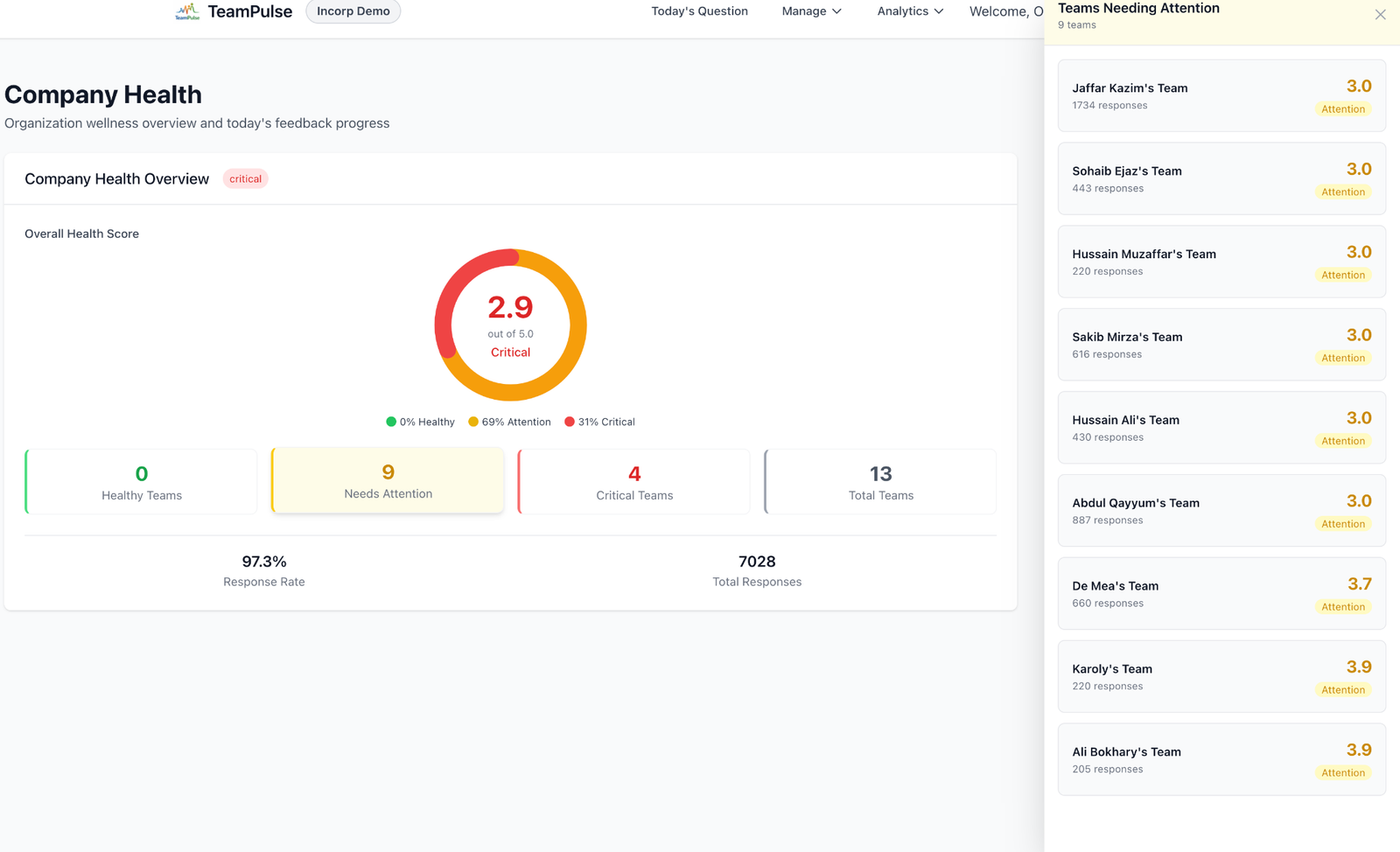
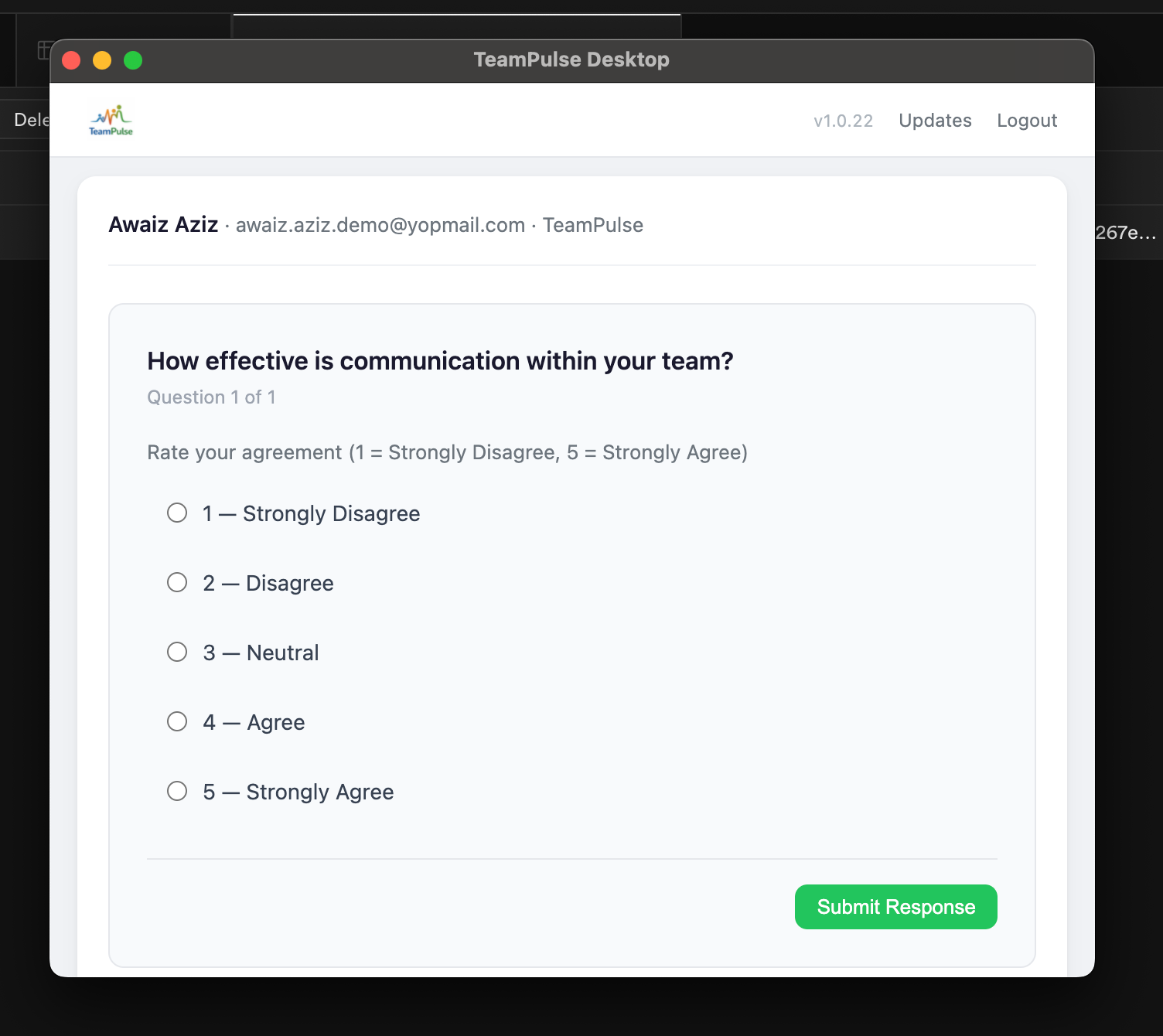
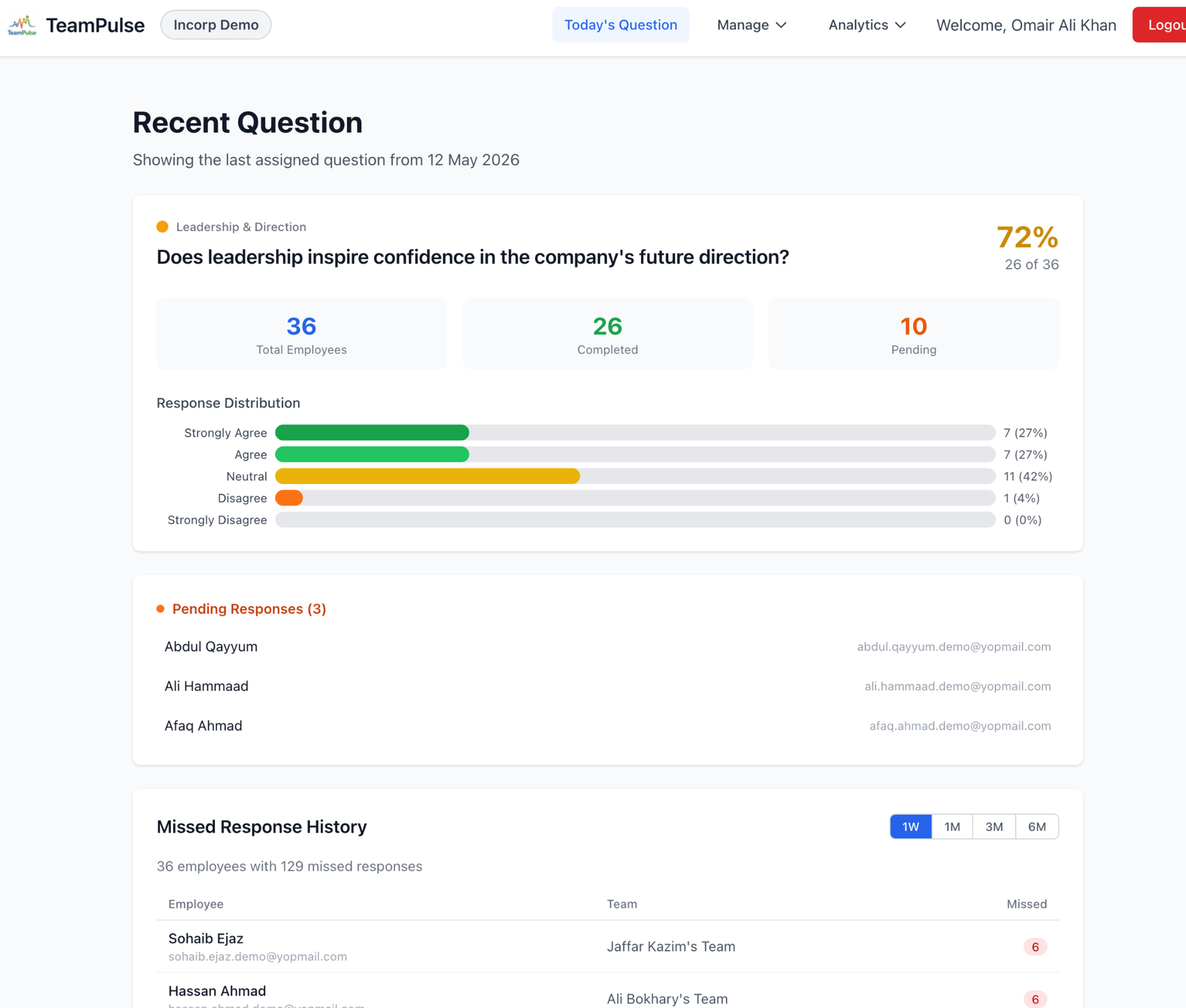
Six strategic dimensions, plus your own
TeamPulse starts with six core dimensions and also lets you add custom dimensions for the signals your organization needs to track.
Why this kind of system works
The research behind TeamPulse is simple: people systems need frequent signals, team-level visibility, and manager accountability.
Frequent feedback beats stale snapshots
Pulse surveys are shorter and make it possible to track changes over time instead of relying only on annual engagement snapshots.
Managers are where engagement becomes real
Gallup reports that managers account for 70% of variance in team engagement. That makes team and manager-level visibility essential.
Organizational health predicts performance
McKinsey describes organizational health as a leading indicator of sustained performance and a source of competitive advantage.
Download the white paper.
A concise executive brief explaining why one-question pulses create a better operating signal for leadership teams - with a 30-day rollout model and CEO dashboard checklist.
The Operating Signal Modern Companies Are Missing
Why lightweight, recurring employee pulses help CEOs detect organizational friction before it becomes attrition, stalled execution, or delivery failure.
Inside: research points, health dimensions, rollout plan, dashboard checklist, and sample questions.
Simple pricing.
TeamPulse is sold as a company-wide operating tool. Pricing depends on organization size, desktop deployment needs, data controls, custom dimensions, and rollout support.
Custom plan for your organization
Best for companies that want leadership visibility, manager analytics, and a repeatable employee listening cadence.
Ready to see what your teams are not saying yet?
Start with one question. Find the signal. Act before the problem gets expensive.
Questions buyers usually ask
Is this anonymous?
Yes, completely. Responses are never tied to individual employees. Leadership only sees aggregated scores at the team level — there is no way to trace a specific answer back to any person. Anonymity is a core architectural principle, not a configuration option.
How is this different from an annual engagement survey?
Annual surveys give a snapshot. TeamPulse creates a recurring operating signal that shows movement by team, manager, category, and question.
Who is this for?
CEOs, founders, HR leaders, and operators who want earlier visibility into leadership, workload, collaboration, resources, growth, culture, and any custom dimensions that matter to their organization.
How often should we ask questions?
TeamPulse is designed around a daily question cadence. The key is to keep each question short, focused, and visibly connected to action.
Can my manager see my individual answers?
No. Managers see team-level health scores and dimension trends only. There is no mechanism in TeamPulse to view, filter, or infer any individual employee's response. The system requires a minimum team size before showing analytics to prevent identification by elimination.